Why Experience Matters in a Construction Superintendent
Luxury custom homes have become increasingly sophisticated. Structural systems, smart-home technology, mechanical equipment, specialty finishes, and highly detailed designs all have to work together, often within spaces where there is little room for error.
That complexity puts tremendous responsibility on the construction superintendent. Plans establish the design, but someone on the jobsite still has to understand how the pieces fit together, recognize conflicts, coordinate the trades, and make sound decisions as conditions change.
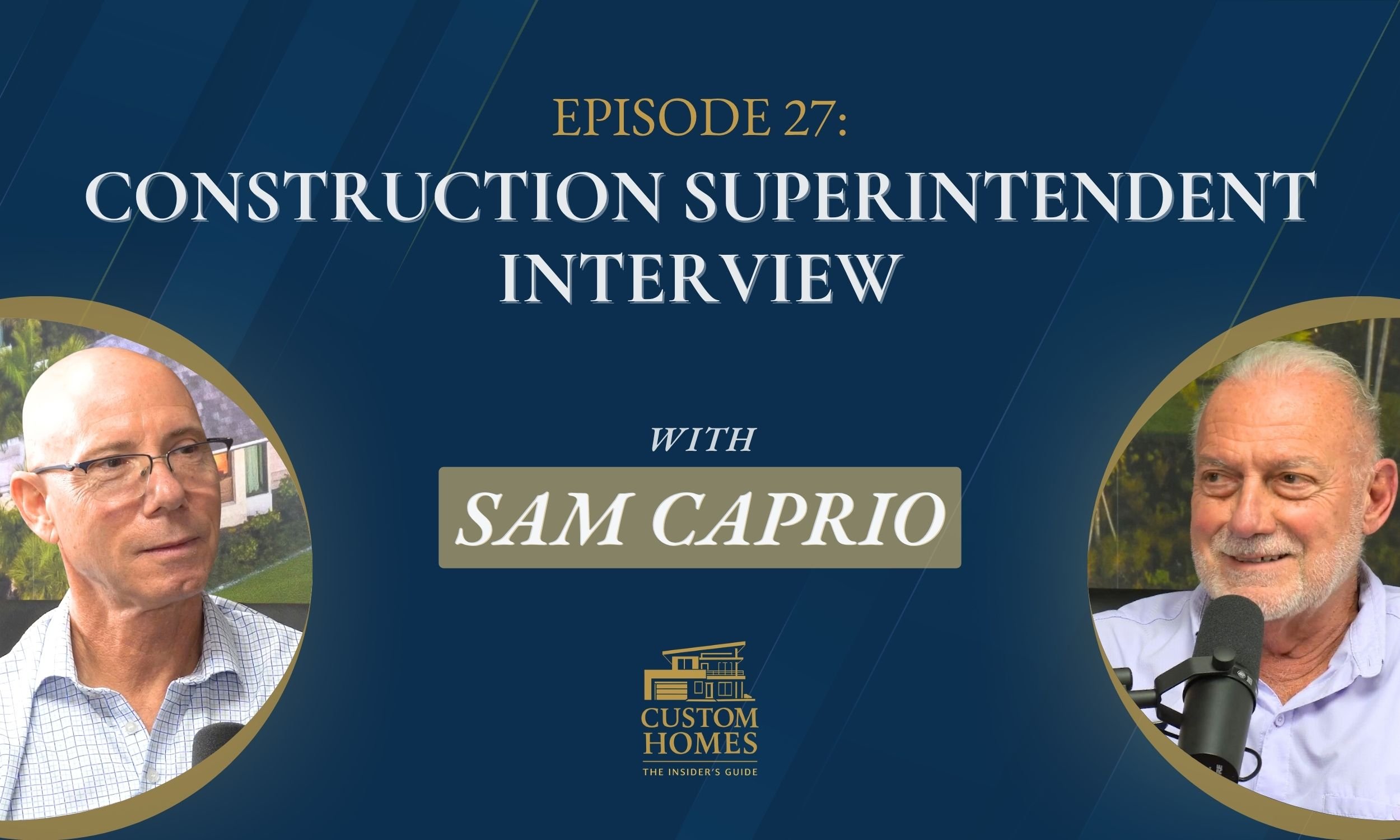
Landmark Custom Homes Lead Superintendent Sam Caprio brings more than 40 years of construction experience to that responsibility, spanning commercial construction, custom residential work, his own building company, and highly complex projects across different regions. Today, he is leading construction of a 54,000-square-foot custom estate, the largest home Landmark has built. His career offers a valuable look at why experience matters when the home itself presents challenges that cannot always be solved by following a set of drawings.
LISTEN TO EPISODE 27 (FULL TRANSCRIPT ON TIGTCH.COM)
Key Takeaways
What a construction superintendent is responsible for on a luxury custom home build, including coordinating trades, managing sequencing, solving field issues, and keeping the project moving
How proper coordination and construction sequencing can prevent delays, reduce costly rework, and keep multiple trades productive when challenges arise
Why clear communication between the superintendent, project team, trade partners, and homeowners is essential to keeping a complex custom home on track
How decades of hands-on construction experience help a superintendent anticipate conflicts, adapt to unfamiliar conditions, and solve problems before they escalate
What strong jobsite leadership looks like and what homeowners should expect from the superintendent overseeing their custom home
Experience Helps a Superintendent See the Whole Project
Sam compares the construction superintendent to the conductor of an orchestra. A conductor doesn’t need to play every instrument, but needs to understand the music well enough to know when each player should come in and what the finished performance should sound like.
The same principle applies to a complex custom home. Electricians, plumbers, HVAC contractors, drywall installers, finish trades, engineers, architects, and designers each have specialized responsibilities. An experienced superintendent understands enough about each scope to coordinate those efforts and recognize when something doesn’t look right.
That perspective becomes increasingly important as luxury homes grow more sophisticated. Sam recalls a time when residential construction involved far fewer trades and considerably less technology. On his current project, he estimates there may be approximately 120 subcontractors involved.
Bringing a custom home construction team together requires more than scheduling individual trades. Experience gives the superintendent a broader view of how one trade’s work can affect another and where coordination needs to happen before work proceeds.
Experience Is Valuable Because Every Custom Home Presents New Problems
Decades in construction don’t mean a superintendent has seen everything. In Sam’s view, experience actually teaches the opposite: there will always be something new to figure out.
That became especially clear when he took on a complex hillside home in California. The construction methods, seismic considerations, waterproofing requirements, and site conditions differed significantly from what he knew in Florida. Rather than imposing familiar methods on an unfamiliar environment, he sought out highly regarded local contractors and learned how successful builders worked under those conditions.
The experience reinforced a valuable trait in a seasoned superintendent: adaptability. Years in the field create a deeper base of construction knowledge, but they also teach you when to ask questions, seek expertise, and adjust your approach.
That matters on today’s luxury homes, where new materials, technology, engineering challenges, and design details continually create unfamiliar conditions. The superintendent’s value isn’t knowing every answer immediately. It’s having the judgment and experience to know how to find the right one.
Good Sequencing Can Keep One Problem From Stopping the Project
Problems don’t automatically have to bring an entire custom home build to a halt. On a large project, an experienced superintendent can often adjust the sequence of work while an issue is being corrected elsewhere.
Sam gives a simple example: if a trade arrives to install material and discovers the underlying work isn’t ready, he doesn’t want them covering a bad condition just to keep moving. Instead, the trade can shift to another area where the work is ready while the original issue is corrected.
The same thinking is being applied to Landmark’s 54,000-square-foot project. Rather than treating the estate as one overwhelming construction task, Sam compartmentalizes it into manageable areas and scopes, continually asking what portions of the home can move forward next.
Keeping a project moving isn't always about following the original sequence rigidly. Sometimes it means knowing when work can be resequenced without compromising quality or creating problems later. Thinking ahead this way can help avoid some of the biggest mistakes when building a custom home.
Experience Makes Communication More Valuable
One of Sam’s most telling observations is that construction professionals may think they’re in the construction business, but they’re really in the communication business.
Trades need timely answers. Architects and engineers need accurate information from the field. Project managers need to understand what is affecting the critical path. And homeowners need construction decisions explained in a way that makes sense without being buried in technical language.
Experience helps a superintendent know which questions need immediate attention and who needs to be involved in solving them. It also helps when conversations become difficult. Rather than simply directing people, Sam emphasizes respect, learning people’s names, understanding personalities, and giving trade partners the information they need to perform well.
Communication with homeowners requires another skill: perspective. A detail that seems obvious to someone who has spent decades reading plans may look entirely different to an owner seeing their home take physical shape for the first time. Good field leadership includes explaining what is happening, presenting a professional recommendation, and helping the homeowner understand how a decision may affect the project.
When a decision affects scope, budget, or timing, well-documented change orders help everyone understand the impact before work moves ahead.
Keeping the Big Picture in View During Custom Home Construction
On a complex custom home, it’s easy to become consumed by the issue directly in front of you. An experienced superintendent still has to keep an eye on what that decision means for the rest of the project.
Sam’s current estate provides an extreme example. Architectural, structural, electrical, HVAC, and drainage systems all have to occupy limited space, and those drawings may be developed separately. When systems conflict in the field, someone has to work through the engineering and find a practical solution without losing sight of the home’s design or critical path.
The same principle applies to homeowner decisions. Sam encourages owners to make thoughtful choices rather than repeated changes, develop the plan with their professional team, and avoid becoming so focused on today’s detail that they lose sight of the finished home. Thoughtful selections and allowances made at the right time can help the project team plan ahead and reduce unnecessary disruption later in construction.
An experienced superintendent can help provide that perspective. The goal isn’t to make decisions for the homeowner, but to recognize when a choice deserves another look and explain why before the work becomes difficult or costly to unwind.
Where an Experienced Construction Superintendent Adds Value
Years in construction matter most when that experience translates into better judgment on the jobsite. On a complex custom home, an experienced construction superintendent can recognize problems earlier, coordinate trades more effectively, adjust sequencing when conditions change, and keep individual decisions connected to the larger project.
Knowing when not to cover a problem
Sam’s rule is simple: don’t put something good on top of something bad. Correcting the underlying condition first can prevent one mistake from affecting everything installed afterward.
Recognizing when the construction sequence needs to change
A delay in one room or area doesn’t necessarily mean every trade has to stop. Experienced field leadership can identify productive work elsewhere while the problem is resolved.
Seeing conflicts beyond a single trade
A solution that works for plumbing may interfere with HVAC, structure, drainage, or another system. Someone needs to consider how those scopes work together.
Knowing when to ask rather than assume
Experience isn’t the same as believing you know everything. Strong superintendents recognize unfamiliar conditions and bring in the right expertise when needed.
Keeping today’s decision in perspective
Small changes can have consequences later in a custom home build. An experienced superintendent considers the effect on quality, sequencing, schedule, and the finished home before work moves forward.
Choosing a Superintendent: Look for More Than Years on a Résumé
Forty years in construction can provide an extraordinary knowledge base, but experience is most valuable when you can see how someone uses it. For homeowners evaluating a custom home builder and its field team, look beyond the number of years and consider what that experience produces on the jobsite.
✔ Ask about the projects they’ve supervised
Look for experience relevant to the scale and complexity of the home you’re planning.
✔ Listen to how they talk about problems
Experienced superintendents should be able to explain how they identify, evaluate, and resolve them.
✔ Look for adaptability
Construction continually changes, and strong field leaders continue learning rather than relying solely on what worked years ago.
✔ Ask how they coordinate multiple trades
Luxury homes require many specialized contractors whose work often overlaps.
✔ Pay attention to communication
Technical knowledge matters, but so does the ability to explain decisions clearly to trades, consultants, and homeowners.
✔ Ask how they protect quality when the schedule is under pressure
Moving quickly should never mean building over a known problem.
✔ Look for support behind the superintendent
Complex projects benefit from a builder with enough depth to provide project management, administrative support, and additional expertise when challenges arise.
✔ Ask how homeowner decisions are handled
A strong superintendent should help explain the practical impact of choices without taking control of decisions that belong to the owner and design team.
✔ Check references for the people who will actually manage your home
Past clients and project partners can provide valuable insight into how that experience translates into real-world performance.
Experience Is More Than Knowing What Worked Before
The most valuable construction experience isn’t simply a collection of answers gathered over decades. It’s the ability to recognize patterns, anticipate consequences, adapt when something unfamiliar appears, and know when another professional needs to be brought into the conversation. On a sophisticated custom home, that judgment can help prevent today’s small issue from becoming tomorrow’s costly problem.
At Landmark Custom Homes, experienced superintendents are supported by a broader project team with the depth to manage the many decisions, trades, and technical challenges involved in luxury construction.
If you’re planning a custom home in South Florida, schedule an appointment with Landmark Custom Homes to discuss your project and meet the team responsible for turning the plans into a finished home.